




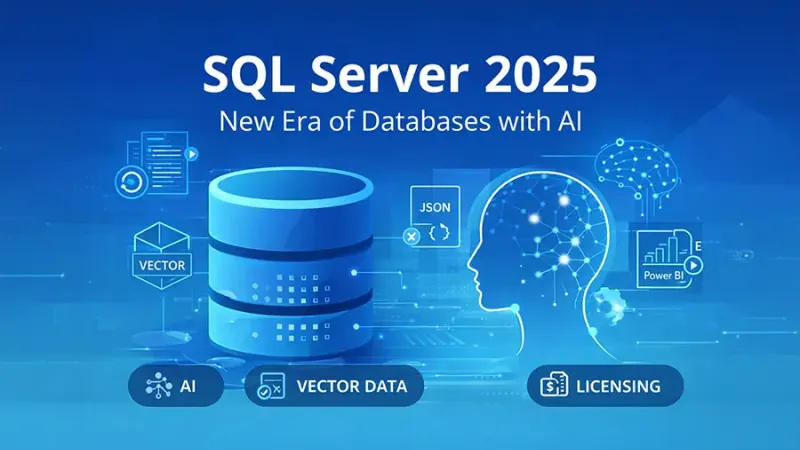
SQL Server 2025: A New Era of Databases with Built-in AI
Microsoft officially released SQL Server 2025 at the end of 2025, delivering the biggest leap yet in modern application development capabilities. While the 2022 version focused primarily on Azure integration (Azure Synapse Link, Managed Instance), SQL Server 2025 goes a step further by embedding intelligence directly into the core database engine.
1. Native AI Support and Vector Data
This is the headline feature of the new release. SQL Server 2025 introduces a native VECTOR data type along with built-in vector search capabilities (powered by DiskANN technology).
- What does this mean in practice? You no longer need an external vector database for your AI models (RAG – Retrieval-Augmented Generation). Data for LLMs (e.g., ChatGPT) can now be stored and queried directly in SQL using semantic search.
- Compared to 2022: SQL Server 2022 provided basic Machine Learning services, while the 2025 version integrates AI capabilities directly into T-SQL.
2. Deep Fabric Integration (Zero-ETL)
Microsoft Fabric has become the central pillar of Microsoft’s data strategy, and SQL Server 2025 is tightly integrated with it at the engine level. The Fabric Database Mirroring feature enables near real-time replication of data into OneLake without the need for complex ETL processes (Extract, Transform, Load).
- Benefit: Analysts can work with up-to-date data in Power BI without placing heavy query loads on the production server.
3. Developer Enhancements: JSON, RegEx, and REST
For developers, SQL Server 2025 introduces three long-awaited improvements:
- Native JSON type: SQL Server 2022 handled JSON as plain text (NVARCHAR). SQL Server 2025 introduces a native binary JSON format, significantly improving processing speed and enabling indexing inside JSON documents.
- Regular Expressions (RegEx): T-SQL now natively supports regular expressions for advanced validation and text searching.
- sp_invoke_external_rest_endpoint: SQL Server can directly call external APIs from stored procedures (e.g., sending notifications or retrieving data from web services).
4. Licensing Changes and Capacity Improvements (Most Important for Budgeting)
With SQL Server 2025, Microsoft surprised many customers by adjusting edition limits, potentially allowing organizations to reduce costs by choosing lower-tier editions.
| Feature | SQL Server 2022 | SQL Server 2025 |
|---|---|---|
| Standard Edition: Max RAM | 128 GB | 256 GB |
| Standard Edition: Max Cores | 24 cores | 32 cores |
| Express Edition: Max Database Size | 10 GB | 50 GB |
| Resource Governor | Enterprise only | Available in Standard edition |
| Power BI Report Server | Enterprise + Software Assurance only | Included in both Standard and Enterprise |
Key Licensing Insights:
- Web Edition discontinued: SQL Server 2025 no longer includes the Web edition. Customers must transition to Standard or move to Azure SQL.
- Power BI Report Server for everyone: You no longer need an expensive Enterprise license with Software Assurance to run Power BI Report Server on-premises.
- Larger Express Edition: A fivefold increase to 50 GB makes the free Express edition a serious option for smaller e-commerce platforms and internal applications.
Summary: Is the Upgrade Worth It?
If your organization plans to implement custom AI models or requires higher throughput in the Standard edition (thanks to increased RAM and core limits), SQL Server 2025 is a clear choice.
For companies that primarily use SQL Server as a traditional database platform, SQL Server 2022 remains a stable and reliable foundation. However, the 2025 release significantly simplifies development and analytics workflows.
Looking to Reduce Your SQL Server Licensing Costs?
At Evosolutions, we specialize in the sale of
secondary (fully legal) Microsoft software licenses.
Contact us for a tailored quotation on SQL Server 2022 or 2025
at significantly more competitive pricing.