




Are Second-Hand Software Licenses Legal? Conditions for Safe Business Purchasing
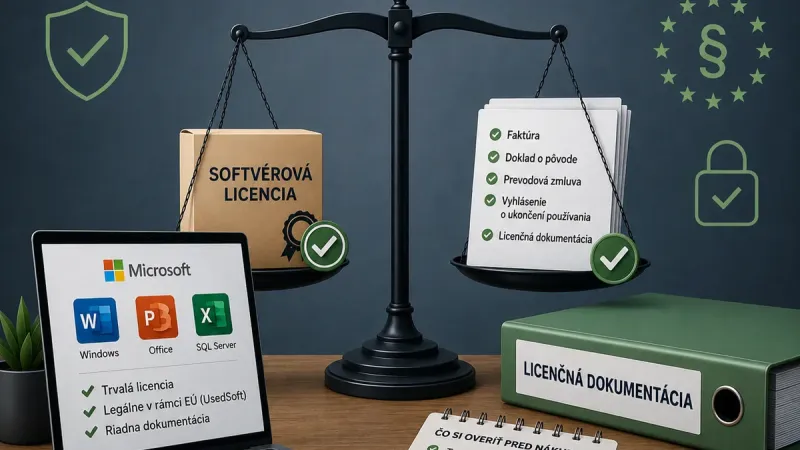
Are Second-Hand Software Licenses Legal? Conditions for Safe Business Purchasing
Second-hand software licenses can help businesses significantly reduce the cost of Microsoft Office, Windows, Windows Server or SQL Server licensing. However, when software is purchased for business use, price and successful activation should not be the only considerations.
The key question is whether the license was originally acquired and subsequently transferred in a way that can be properly documented.
What matters is not simply whether a license is described as "used" or "second-hand", but its specific type, origin, method of original acquisition, discontinuation of use by the previous holder and the documentation supporting the transfer.
What Is a Second-Hand Software License?
A second-hand or used software license is a license that was previously acquired by another user and is subsequently transferred to a new purchaser, provided that the relevant conditions for such a transfer are met.
In practice, these are often perpetual Microsoft licenses that a company no longer needs after:
- moving to Microsoft 365,
- migrating to a newer software version,
- restructuring the company,
- reducing the number of workstations,
- consolidating IT infrastructure,
- moving part of its systems to the cloud.
Instead of remaining unused, suitable licenses may enter the secondary software market and be acquired by another business.
What Is the Legal Basis for Second-Hand Software in the EU?
One of the key legal principles relevant to the secondary software market is the exhaustion of the distribution right.
In simplified terms, once the relevant legal conditions have been met, the rights holder does not necessarily retain unlimited control over every subsequent transfer of a particular copy of software that has already been placed on the market.
An important decision in this area is the judgment of the Court of Justice of the European Union in Case C-128/11 UsedSoft GmbH v Oracle International Corp.
The Court considered, among other issues, the subsequent transfer of rights to use software distributed via the internet.
The judgment is particularly significant because, under certain circumstances, the principle of exhaustion of the distribution right can also apply to software supplied by download rather than exclusively on physical media.
Does This Mean That Every Software License Can Be Resold?
No.
The legal framework for second-hand software should not be simplified into the assumption that every software license or every product key can automatically be transferred.
For each license, it is important to consider factors such as:
- whether it is a suitable type of license,
- whether the right to use the software was granted for an unlimited period,
- how and where the license was originally placed on the market,
- whether the original license was properly acquired,
- whether the previous holder has discontinued its use,
- whether sufficient documentation of the license origin and transfer is available.
1. A Perpetual License and a Subscription Are Not the Same
One of the fundamental distinctions on the secondary software market is the difference between a perpetual license and a subscription.
A perpetual license generally grants the right, subject to the applicable terms, to use a particular software version without a predefined end to the licensing period.
Microsoft 365 and similar services, on the other hand, operate on a subscription basis.
Subscription services therefore cannot automatically be assessed in the same way as perpetual software licenses.
2. The Origin of the License Should Be Traceable
For a business purchase, it is not enough simply to be told that a license "comes from Europe".
There should be documentation that allows the origin and acquisition of the license to be established.
Depending on the particular case, relevant documentation may include:
- original invoices,
- license statements or summaries,
- purchase orders or agreements,
- information identifying the original purchaser,
- documentation relating to individual transfers.
The more transparent the licensing history is, the easier it is for a company to demonstrate its entitlement to use the software if the licensing position is later reviewed.
3. The Previous User Must Discontinue Use
A single transferred license cannot simply continue to be used independently by two different companies merely because a product key has been passed from one party to another.
As part of the transfer, the previous user must discontinue the use of the transferred license.
Depending on the particular circumstances, this may be supported by a written declaration confirming that the previous user has discontinued use, sometimes referred to as a deletion statement.
4. Transfer Documentation Is as Important as the Software Itself
During a software license audit, a company should not rely solely on the fact that a product successfully passed online activation.
A product or activation key is primarily a technical mechanism used to activate software. It is not automatically complete evidence of the origin and transfer of the underlying license entitlement.
A professional supply of second-hand software should therefore include documentation appropriate to the particular license and method of acquisition.
Fast delivery and successful activation alone do not establish whether the purchaser has received the documentation required to demonstrate the origin and acquisition of the license.
5. What About Volume Licenses?
Business environments often use larger licensing packages or volume licensing programs.
Whether a particular part of a licensing volume can be transferred depends on the specific software product, licensing program and the circumstances under which the licenses were originally acquired.
For the purchasing company, it is important to be able to establish:
- which licensing program the license originated from,
- how many licenses are included in the particular transfer,
- how the transferred licenses relate to the original licensing volume,
- which documentation applies to the licenses being acquired.
Which Documents Should a Business Keep?
The exact documentation required may vary depending on the software product and licensing model. Businesses purchasing second-hand software should nevertheless retain all relevant licensing documentation for the long term.
This may include:
- the purchase invoice,
- precise identification of the product and edition,
- information concerning the origin of the license,
- documents relating to individual transfers,
- confirmation that the previous holder discontinued use, where relevant,
- additional documentation applicable to the licensing program.
It is advisable to retain these documents even several years after the original purchase.
Second-Hand Licenses and Software Audits
During a software audit or internal compliance review, a company may need to demonstrate why it is entitled to use a particular software product.
For second-hand software, this may involve more than simply presenting an invoice from the current supplier. Documentation concerning the origin and previous transfer of the license may also be relevant.
An internal licensing archive should therefore be organized so that the company can quickly identify:
- what software was purchased,
- how many licenses were acquired,
- who supplied the licenses,
- which licensing model applies,
- which documents support the right to use the software.
How Can You Identify a Reliable Second-Hand Software Offer?
Price should not be the only consideration when choosing a supplier.
Before purchasing, a business should be able to obtain clear answers to questions such as:
- What exact type of license is being supplied?
- Is the license perpetual or time-limited?
- What is the origin of the license?
- Which documents will be supplied with it?
- Has the previous user discontinued the use of the transferred license?
- Is the license suitable for the company's intended deployment?
If a supplier cannot clearly explain basic information about the license origin and documentation, a low price alone should not be the reason to proceed with the purchase.
When Can Second-Hand Licenses Make Economic Sense?
Second-hand software can be particularly attractive to businesses that do not always require the latest software version or recurring cloud services.
It may be worth considering for:
- Microsoft Office LTSC,
- Windows Server,
- SQL Server,
- CAL licenses,
- expanding an existing environment with the same software version,
- systems where compatibility with an older software version is important.
A properly designed licensing solution can help reduce software costs without automatically requiring a business to move to a subscription-based model.
How Can EvoSolutions Help?
EvoSolutions helps businesses select and optimize software licenses with a focus on business deployment, licensing models and appropriate documentation.
We can assist with:
- selecting suitable second-hand Microsoft licenses,
- assessing licensing models,
- Windows Server and SQL Server licensing,
- CAL licensing,
- reviewing licensing documentation,
- optimizing software licensing costs,
- buyback of unused software licenses.
Are You Considering Second-Hand Licenses for Your Business?
Business software licensing should not be based on price alone. We can help you assess the product, licensing model, documentation and suitability for your IT environment.
Contact EvoSolutions and request a suitable software licensing solution for your organization.
Frequently Asked Questions
Are second-hand software licenses legal?
Subject to the relevant conditions, the subsequent transfer of certain perpetual software licenses within the EU and EEA may be possible. Each license should nevertheless be assessed according to its type, origin, method of acquisition and supporting documentation.
Is a product key proof of a valid license?
A product key is primarily used for technical activation. For business use, the company should also be able to demonstrate the relevant license entitlement and how it was acquired.
Can Microsoft 365 be purchased as a second-hand license?
Microsoft 365 operates as a subscription service and is therefore not assessed in the same way as a perpetual license for a particular software version.
Does the previous user have to stop using the software?
As part of a valid transfer, the previous holder must discontinue the use of the transferred license.
What should we keep in case of a software audit?
A company should retain invoices and other relevant documentation concerning the origin, identification and transfer of the software license. The exact documentation may vary according to the product and licensing model.
This article is provided for informational purposes only and does not constitute legal advice. Each specific licensing situation should be assessed individually.