




Unused Microsoft Licenses Have Value: How Software License Buyback Works
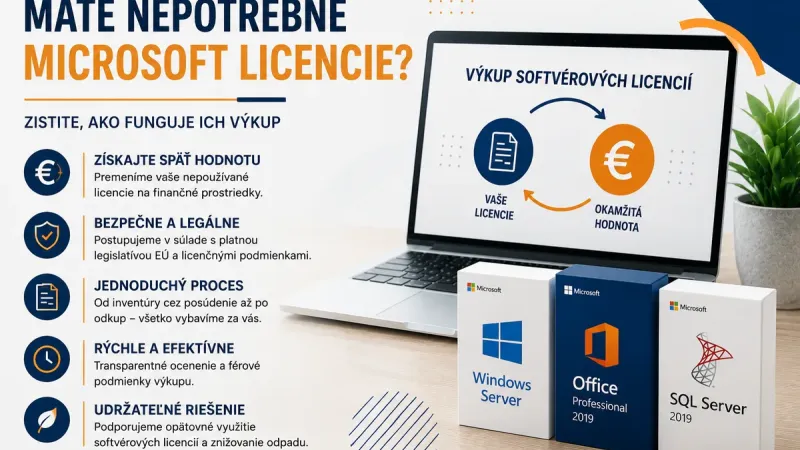
Unused Microsoft Licenses Have Value: How Software License Buyback Works
Has your company moved to Microsoft 365, modernized its IT infrastructure, reduced the number of workstations or stopped using part of its server environment? If so, you may have perpetual software licenses that are no longer actively used.
These licenses do not necessarily have to remain unused IT assets. If they are suitable for transfer and the relevant conditions are met, it may be possible to sell them and recover part of the original investment.
If a company owns suitable perpetual software licenses, has stopped using them and can demonstrate their origin, there may be an opportunity to transfer them to another purchaser. Each license must, however, be assessed individually according to the product, licensing model and available documentation.
Why Do Companies End Up with Unused Software Licenses?
A company's software environment naturally changes over time. Products that were once essential may no longer be required following a migration, restructuring or modernization project.
Common reasons for surplus software licenses include:
- moving from perpetual licenses to Microsoft 365,
- migrating to newer software versions,
- moving part of the IT infrastructure to the cloud,
- reducing the number of employees,
- closing an office, branch or business unit,
- company mergers or acquisitions,
- consolidating IT infrastructure,
- decommissioning servers,
- ending a project for which the software was originally purchased.
As a result, a company may have a significant number of licenses that remain on its records but are no longer actively used.
Can Unused Software Licenses Be Sold?
Under certain conditions, the subsequent transfer of some software licenses within the European Economic Area may be possible.
An important legal milestone in this area is the judgment of the Court of Justice of the European Union in Case C-128/11 UsedSoft GmbH v Oracle International Corp., which addressed the principle of exhaustion of the distribution right in relation to software.
This does not mean that every software license can automatically be resold. Before a license buyback or transfer, it is important to assess factors such as:
- the specific type of software license,
- how the license was originally acquired,
- the territory in which it was originally placed on the market,
- whether the right to use the software was granted for an unlimited period,
- the availability of supporting documentation,
- whether the original license holder is still using the software,
- any additional conditions applicable to the specific licensing model.
Which Licenses May Be Suitable for Buyback?
The secondary software market is particularly relevant for perpetual software licenses that were acquired for an unlimited period of use.
Depending on the individual circumstances, suitable licenses may include certain licenses for:
- Microsoft Office,
- Microsoft Windows,
- Microsoft Windows Server,
- Microsoft SQL Server,
- Windows Server CALs,
- SQL Server CALs,
- Remote Desktop Services CALs,
- other business software with an appropriate licensing model.
Large organizations in particular may have a substantial volume of licenses left unused following a migration, restructuring or infrastructure consolidation.
Which Licenses Require Special Assessment?
Not every license is suitable for resale. Products tied to subscriptions, specific hardware or special licensing programs require individual assessment.
Particular attention should be paid to:
- subscription products such as Microsoft 365,
- OEM licenses tied to specific hardware,
- academic or educational licenses,
- NFR licenses,
- upgrade licenses without the corresponding qualifying base license,
- licenses acquired through specific cloud or transformation programs.
The fact that a company no longer uses a particular software product does not automatically mean that the license can be sold. The licensing model, origin of the license and relevant documentation should always be reviewed before a transfer.
How Does Software License Buyback Work?
A professional software license buyback process should begin with an assessment of what the company owns and whether those licenses are suitable for subsequent transfer rather than with an immediate price offer.
1. License Inventory
The first step is to prepare a list of licenses that the company no longer uses or intends to retire.
Ideally, the inventory should include:
- product name,
- version and edition,
- number of licenses,
- type of licensing program,
- approximate date or period of the original purchase,
- available documentation.
2. Verification of Origin and Documentation
The next step is to review the documentation relating to the original acquisition of the licenses.
Relevant documents may include:
- invoices,
- purchase orders and agreements,
- license statements or summaries,
- information from licensing portals,
- other documents demonstrating the origin of the licenses.
The clearer the licensing history and supporting documentation, the easier it is to assess the possibility of a subsequent transfer.
3. Assessment of Transferability
At this stage, the licenses are reviewed to determine which ones may be suitable for further consideration based on their type, origin, licensing model and documentation.
4. License Valuation
If the licenses are suitable for transfer, their current market value can be assessed.
The value may be influenced by factors including:
- the specific software product,
- version and edition,
- number of licenses,
- current market demand,
- availability of the product on the secondary market,
- quality and completeness of the documentation.
5. Discontinuation of Use
As part of a valid transfer, the original license holder must no longer use the transferred licenses.
Depending on the specific situation, it may be necessary to uninstall or deactivate the software, otherwise discontinue its use and appropriately document this step.
6. Transfer Documentation
The final stage involves preparing the relevant transfer documentation and completing the commercial transaction.
The objective is to maintain a documented chain of origin and transfer so that the subsequent purchaser can demonstrate how the license was acquired.
What Determines the Buyback Price?
There is no universal price that can be applied to every software license.
The market value is influenced primarily by:
- demand for the particular software product,
- software version and edition,
- number of licenses,
- quality and completeness of the documentation,
- current conditions on the secondary software market.
An older software version does not necessarily have zero value. Some organizations intentionally continue to use particular older versions because of compatibility with existing systems or because they prefer perpetual licensing over a subscription model.
Can a Company Sell Only Part of Its Licenses?
In some circumstances, it may be possible to transfer only part of a licensing volume while retaining the remaining licenses within the company.
Whether such a partial transfer is possible depends on the specific licensing model, the way the licenses were originally acquired and the conditions applicable to the particular product. Each situation should therefore be assessed individually.
What If the Original Documentation Is Missing?
If the original documents are not immediately available, this does not necessarily mean that they cannot be recovered.
Older documentation may sometimes be found:
- in company accounting records,
- in archived purchase orders,
- through the original software supplier,
- in licensing portals,
- in archived email correspondence or contracts.
Without sufficient evidence of the license's origin, however, it may not be possible to safely proceed with a subsequent transfer.
When Is It Worth Considering a Software License Buyback?
A license buyback assessment may be particularly worthwhile when your company:
- is moving to Microsoft 365 or another cloud platform,
- is modernizing a significant part of its IT infrastructure,
- is reducing the number of workstations,
- is closing an office, branch or business unit,
- is merging companies or IT environments,
- is decommissioning servers,
- has a significant number of licenses that have remained unused for a long period.
Do You Have Microsoft Licenses You No Longer Use?
EvoSolutions can help you assess the type of licenses you own, review the available documentation, evaluate the possibility of subsequent transfer and determine their current market value.
Send us a list of your unused software licenses and request a non-binding assessment of their buyback potential.
Frequently Asked Questions
Can Microsoft Office licenses be sold?
Certain perpetual Microsoft Office licenses may be suitable for subsequent transfer if the relevant conditions are met. The specific license type, origin and available documentation are important factors.
Can Microsoft 365 licenses be sold?
Microsoft 365 is based on a subscription model and should not automatically be treated in the same way as a perpetual software license. The specific product and licensing model must be identified and assessed individually.
Do we have to stop using licenses that we sell?
As part of a valid transfer, the original license holder must no longer use the transferred license in a manner inconsistent with the conditions applicable to that transfer.
How much are our unused licenses worth?
The value depends on the specific product, version, edition, quantity, current market demand and available documentation. Each portfolio therefore requires an individual assessment.
What information is needed for an initial assessment?
Ideally, prepare a list of products, versions, editions and quantities together with any available documents relating to their original acquisition.
Turn Unused Software Licenses into Value
If your company owns software licenses that are no longer required, reviewing their potential for further use or resale can form part of an effective IT asset and cost management strategy.
Contact EvoSolutions and send us your license inventory for a non-binding assessment.
This article is provided for informational purposes only and does not constitute legal advice. The possibility of transferring a particular software license should always be assessed individually.