




An Activation Key Is Not Enough: How to Safely Buy a Second-Hand Software License
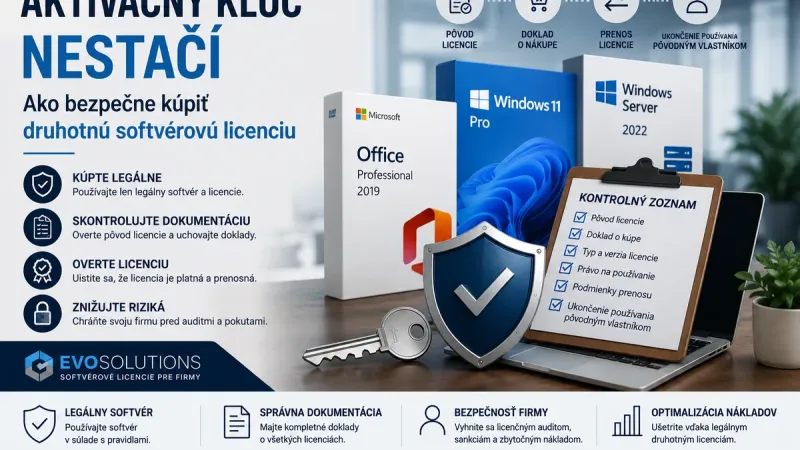
An Activation Key Is Not Enough: How to Safely Buy a Second-Hand Software License
Does your company use dozens or even hundreds of computers, servers and user accounts? If so, you should have a clear overview not only of the software you use, but also of the licenses covering its use and the documentation available for those licenses.
The fact that Microsoft Windows, Office, Windows Server or SQL Server has been successfully activated does not automatically mean that your licensing documentation is complete.
A product key is primarily used for the technical activation of software. For business use, however, it is also important to be able to demonstrate the right to use the respective software and to have appropriate documentation related to how the license was acquired.
What Is a Software License Audit?
A software or license audit is a review in which the software actually being used within an organization is compared with the licenses the organization has available.
A company should be able to answer questions such as:
- How many devices use Microsoft Windows or Microsoft Office?
- Which software versions and editions are installed?
- How many servers and processor cores need to be licensed?
- Does the company have the correct number of Windows Server CALs?
- Does it use User CALs or Device CALs, and does this model correspond to its infrastructure?
- How is Microsoft SQL Server licensed?
- What is the origin of the individual licenses?
- Does the company have the necessary license documentation?
Why Might an Activation Key Not Be Enough?
An activation key is a technical tool. It can be used to activate a particular software product, but the ability to activate software is not the same as demonstrating the right to use it.
A simple comparison is a car key. A key allows you to unlock and start a vehicle. Possessing the key alone, however, does not prove how you acquired the vehicle or whether you have the right to use it.
The same principle applies to software. Companies should therefore consider more than whether a product works and passes online activation. It is also important to know where the software came from, what type of license was acquired and what documentation is available to support the acquisition.
The Risk of Extremely Cheap Product Keys
There are many online offers for Microsoft Windows, Office and other software products at extremely attractive prices.
The purchasing process is usually simple: the customer pays and receives a product key by email shortly afterwards.
From a technical perspective, everything may appear to work correctly. For a business customer, however, there is another important question:
What exactly did we acquire together with this product key?
If the seller cannot provide appropriate information and documentation concerning the license, it may later become difficult to demonstrate its origin and the scope of the acquired usage rights.
Second-Hand Software Licenses Are Not the Same as Anonymous Product Keys
The terms second-hand software license and cheap activation key should not automatically be treated as the same thing.
Second-hand software generally refers to software licenses that have already been placed on the market and which, subject to the relevant conditions, may subsequently be transferred to another purchaser.
One of the most significant decisions in this area is the judgment of the Court of Justice of the European Union in Case C-128/11 UsedSoft GmbH v Oracle International Corp., which addressed the principle of exhaustion of the distribution right in relation to software.
This does not mean, however, that every license or product key offered online can automatically be transferred. The specific product, licensing model, origin of the license and circumstances surrounding its acquisition must always be considered.
What Documentation Should a Company Keep?
The exact scope of the documentation depends on the particular license and the way in which it was acquired. However, businesses should systematically retain documents relating to software purchases and licensing rights.
For second-hand licenses, relevant documentation may include, depending on the individual case:
- an invoice or other proof of purchase,
- identification of the acquired software product,
- information regarding the origin of the license,
- documentation relating to the transfer of the license,
- statements concerning the discontinuation of use by the previous license holder, where relevant,
- other documents appropriate to the particular licensing model.
Microsoft Windows Server: Licensing Can Be More Complex
Correct licensing becomes even more important with server products. Simply counting the number of physical servers may not be enough.
Depending on the product and deployment, licensing considerations may include:
- physical processors and processor cores,
- the number of virtual environments,
- Windows Server Standard or Datacenter edition,
- the number of users and devices accessing the server,
- User CALs and Device CALs,
- Remote Desktop Services CALs, where required,
- the deployment and virtualization model.
An incorrectly designed server licensing model can lead not only to licensing issues but also to unnecessarily high IT costs.
Perform an Internal License Audit Before You Need One
The best time to review your software licenses is when you have enough time to address any issues that may be identified.
A company can begin with a simple internal review:
- Create an inventory of the software currently in use.
- Determine the number of devices, servers and users.
- Collect invoices and available licensing documentation.
- Compare the licenses acquired with the actual software deployment.
- Identify missing or surplus licenses.
- Check whether the current licensing model remains economically efficient.
Did You Know That Your Company May Also Have Surplus Licenses?
A software license audit does not only identify missing licenses. Following a migration, restructuring or transition to cloud services, a company may own perpetual software licenses that it no longer uses.
In such cases, selling unused software licenses may also be worth considering.
How Can EvoSolutions Help?
EvoSolutions specializes in helping companies and organizations optimize the cost of their software licensing.
We can assist you with:
- designing an appropriate software licensing solution,
- second-hand software licenses,
- new Microsoft licenses,
- Microsoft 365 and hybrid solutions,
- Windows Server and SQL Server licensing,
- reviewing your current licensing position,
- purchasing surplus and unused software licenses.
Not Sure About the Current State of Your Software Licenses?
Do not wait until incomplete licensing documentation becomes a problem. We can help you review your current situation and propose a cost-effective licensing solution tailored to your organization.
Contact EvoSolutions and let us prepare an individual licensing solution for your company.
Frequently Asked Questions
Is an activation key the same as a software license?
A product or activation key is a technical element used to activate software. For business use, it is also important to consider the underlying licensing rights and the documentation relating to how the software license was acquired.
Are second-hand Microsoft licenses legal?
Subject to the relevant conditions, the subsequent transfer of certain software licenses within the European Union may be possible. Important factors include the specific type of license, its origin, the way it was originally acquired and whether the conditions applicable to its subsequent transfer have been satisfied.
What should we do if we do not have documentation for all our licenses?
We recommend starting with an internal review and collecting all available invoices, orders, agreements, emails and licensing documents. The available documentation can then be compared with the software actually deployed within the organization.
Is a software audit useful even without an external auditor?
Yes. An internal software license review can help identify missing licenses, unsuitable licensing models and surplus software licenses that the company no longer needs.
Can second-hand software licenses reduce IT costs?
Yes. Where an appropriate second-hand licensing solution is available and the relevant requirements are met, businesses may be able to significantly reduce software acquisition costs compared with purchasing new licenses.
What should we check before purchasing a second-hand software license?
Before purchasing, check the exact product and edition, the type and origin of the license, the documentation provided with it and whether the license is suitable for your intended deployment. For server products and larger business environments, professional licensing advice is recommended.
Looking for Microsoft Licenses for Your Business?
Whether you need Microsoft Windows, Office, Windows Server, SQL Server or CAL licenses, selecting the right licensing model can help your organization reduce costs while maintaining a properly documented software environment.
Contact EvoSolutions for help selecting the right software licensing solution for your business.
This article is provided for informational purposes only and does not constitute legal advice. Each specific licensing situation should be assessed individually.