




Why Secondary Software Makes Sense for Government: Savings, Compliance, and Efficiency
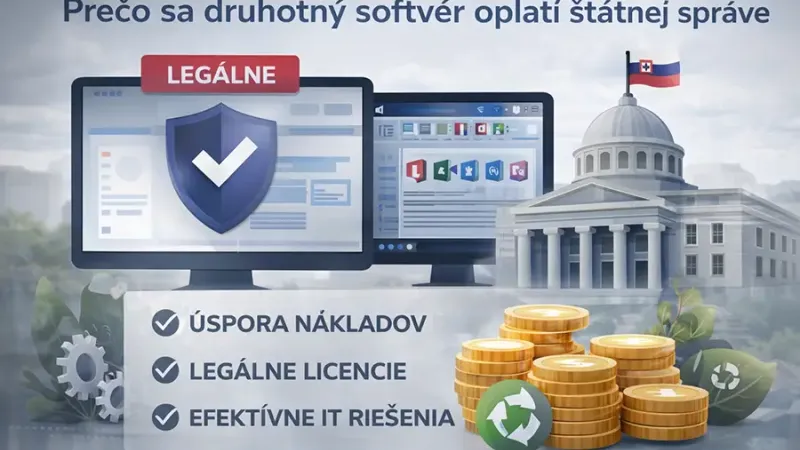
Why Secondary Software Is Worth It for the Public Sector
Digitalization of public administration is now a necessity. Public institutions are increasingly investing in IT solutions that streamline services for citizens, improve internal processes, and enhance transparency. At the same time, however, they face one major challenge – limited budgets.
This is where a solution comes into play that is being increasingly discussed across Europe: secondary software.
What Is Secondary Software?
Secondary software refers to legally acquired software licenses that the original owner no longer uses and resells. This model is fully compliant with EU legislation and allows organizations to purchase original software at significantly lower prices.
For the public sector, this means the opportunity to obtain the same technological solutions as the commercial sector – but under much more favorable conditions.
Significant Savings of Public Funds
One of the biggest benefits is financial savings. Public sector organizations often require dozens or even hundreds of licenses – whether for offices, schools, or government institutions.
By purchasing secondary software, they can save:
- 30% to 70% compared to the price of new licenses
- Thousands to tens of thousands of euros annually
- Funds that can be reinvested into infrastructure or citizen services
At a time of rising costs, this approach is highly efficient.
Legality and Security Without Compromise
One of the most common concerns is legality. It is important to emphasize that secondary software is fully legal within the European Union, provided that the established conditions are met.
Reliable providers, such as Evosolutions, ensure:
- Complete documentation of the origin of the licenses
- Legal certainty for public institutions
- A transparent purchasing process
This allows public administration to use software without any legal risks.
Sustainability and an Eco-Friendly Approach
Secondary software is not only an economic solution but also an ecological one. Reusing licenses means:
- Less pressure on the production of new products
- A lower digital footprint
- Support for the circular economy
For public administration striving to be environmentally responsible, this is an important step toward sustainability.
Flexibility in IT Modernization
Budget constraints often slow down the modernization of IT systems. However, secondary licenses make it possible to:
- Upgrade outdated software more quickly
- Legally use stable versions without the need for costly upgrades
- Adapt purchases to current needs
This means greater flexibility in planning IT strategy.
An Ideal Solution for Offices and Organizations
Secondary software is suitable for a wide range of public sector organizations:
- Ministries and central government offices
- Public organizations and agencies
- Schools and educational institutions
- Cultural and social institutions
Each of these institutions can optimize their costs without reducing the quality of the software they use.
Why Work with an Expert
Choosing the right partner is key. Companies like Evosolutions offer not only license sales but also:
- Expert consulting
- Audits of existing licenses
- Recommendations for optimizing IT costs
This gives public administration the confidence that its investments are efficient and secure.
Conclusion
Secondary software represents a modern, cost-effective, and environmentally friendly approach to IT management in the public sector. At a time when every public euro matters, it is a solution that makes sense.
Investing in secondary licenses is not a compromise – it is a strategic decision that delivers immediate value.